Neste artigo você encontrará exercícios resolvidos de matrizes, com foco em
matriz quadrada,
matriz identidade,
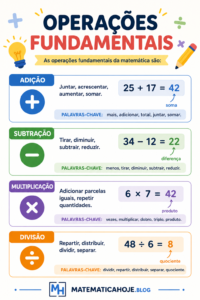
matriz oposta e operações como adição, subtração e multiplicação.
O conteúdo é ideal para quem se prepara para o ENEM, vestibulares e concursos públicos.
Ao longo do texto, você terá acesso a 15 exercícios de múltipla escolha, organizados em grau progressivo de dificuldade e com gabarito explicado.
Aproveite também para conhecer nossos materiais de apoio:
mapas mentais de matemática,
banco de questões e a
coleção de eBooks que complementam seus estudos.
Exercício 1: Calcule \(A+B\), sendo
\(A=\begin{bmatrix}1 & 2\\3 & 4\end{bmatrix},\;
B=\begin{bmatrix}2 & 0\\1 & 5\end{bmatrix}.\)
a) \(\begin{bmatrix}3 & 2\\4 & 9\end{bmatrix}\)
b) \(\begin{bmatrix}2 & 2\\3 & 9\end{bmatrix}\)
c) \(\begin{bmatrix}3 & 2\\4 & 8\end{bmatrix}\)
d) \(\begin{bmatrix}1 & 2\\3 & 4\end{bmatrix}\)
Mostrar solução
\(A+B=\begin{bmatrix}1+2 & 2+0\\3+1 & 4+5\end{bmatrix}=\begin{bmatrix}3 & 2\\4 & 9\end{bmatrix}\).
Resposta: a)
Exercício 2: Subtraia \(A-B\), sendo
\(A=\begin{bmatrix}4 & 5\\7 & 2\end{bmatrix},\;
B=\begin{bmatrix}2 & 3\\1 & 0\end{bmatrix}.\)
a) \(\begin{bmatrix}6 & 8\\8 & 2\end{bmatrix}\)
b) \(\begin{bmatrix}2 & 2\\6 & 2\end{bmatrix}\)
c) \(\begin{bmatrix}2 & 3\\6 & 2\end{bmatrix}\)
d) \(\begin{bmatrix}4 & 5\\7 & 2\end{bmatrix}\)
Mostrar solução
\(A-B=\begin{bmatrix}4-2 & 5-3\\7-1 & 2-0\end{bmatrix}=\begin{bmatrix}2 & 2\\6 & 2\end{bmatrix}\).
Resposta: b)
Exercício 3: Multiplique a matriz \(A=\begin{bmatrix}2 & -1\\0 & 3\end{bmatrix}\) pelo escalar \(k=3\).
a) \(\begin{bmatrix}5 & -4\\0 & 9\end{bmatrix}\)
b) \(\begin{bmatrix}6 & -3\\0 & 9\end{bmatrix}\)
c) \(\begin{bmatrix}6 & -3\\3 & 9\end{bmatrix}\)
d) \(\begin{bmatrix}2 & -1\\0 & 3\end{bmatrix}\)
Mostrar solução
\(3A=\begin{bmatrix}6 & -3\\0 & 9\end{bmatrix}\).
Resposta: b)
Exercício 4: Considere as matrizes
\(A=\begin{bmatrix}1 & 0\\2 & 1\end{bmatrix}\),
\(B=\begin{bmatrix}3 & 2\\1 & 4\end{bmatrix}\).
Calcule \(A\cdot B\).
a) \(\begin{bmatrix}3 & 2\\7 & 8\end{bmatrix}\)
b) \(\begin{bmatrix}1 & 2\\2 & 5\end{bmatrix}\)
c) \(\begin{bmatrix}3 & 2\\5 & 6\end{bmatrix}\)
d) \(\begin{bmatrix}2 & 1\\4 & 2\end{bmatrix}\)
Mostrar solução
\(AB=\begin{bmatrix}1\cdot3+0\cdot1 & 1\cdot2+0\cdot4\\2\cdot3+1\cdot1 & 2\cdot2+1\cdot4\end{bmatrix}=\begin{bmatrix}3 & 2\\7 & 8\end{bmatrix}\).
Resposta: a)
Exercício 5: Calcule a soma \(A+B\), sabendo que
\(A=\begin{bmatrix}2 & -3 & 1\\4 & 0 & -2\end{bmatrix},\;
B=\begin{bmatrix}-1 & 5 & 0\\6 & 2 & -4\end{bmatrix}.\)
a) \(\begin{bmatrix}1 & 2 & 1\\10 & 2 & -6\end{bmatrix}\)
b) \(\begin{bmatrix}1 & 2 & 1\\10 & 2 & -2\end{bmatrix}\)
c) \(\begin{bmatrix}1 & -2 & 1\\2 & 0 & -6\end{bmatrix}\)
d) \(\begin{bmatrix}3 & 8 & 2\\0 & 2 & -6\end{bmatrix}\)
Mostrar solução
\(A+B=\begin{bmatrix}2+(-1) & -3+5 & 1+0\\4+6 & 0+2 & -2+(-4)\end{bmatrix}=\begin{bmatrix}1 & 2 & 1\\10 & 2 & -6\end{bmatrix}\).
Resposta: a)
Exercício 6: Uma empresa representou em forma de matriz os custos de dois setores. A matriz
\(A=\begin{bmatrix}120 & 150\\80 & 100\end{bmatrix}\) corresponde aos valores em mil reais do Setor 1 e
a matriz \(B=\begin{bmatrix}60 & 50\\40 & 30\end{bmatrix}\) aos valores do Setor 2.
Calcule a matriz \(A-B\).
a) \(\begin{bmatrix}60 & 100\\40 & 70\end{bmatrix}\)
b) \(\begin{bmatrix}60 & 100\\120 & 70\end{bmatrix}\)
c) \(\begin{bmatrix}180 & 200\\120 & 130\end{bmatrix}\)
d) \(\begin{bmatrix}120 & 150\\80 & 100\end{bmatrix}\)
Mostrar solução
\(A-B=\begin{bmatrix}120-60 & 150-50\\80-40 & 100-30\end{bmatrix}=\begin{bmatrix}60 & 100\\40 & 70\end{bmatrix}\).
Resposta: a)
Exercício 7: Dada a matriz \(A=\begin{bmatrix}2 & -1\\1 & 3\end{bmatrix}\),
multiplique-a pelo número real \(k=-2\) e assinale a alternativa correta.
a) \(\begin{bmatrix}-4 & 2\\-2 & -6\end{bmatrix}\)
b) \(\begin{bmatrix}4 & -2\\2 & 6\end{bmatrix}\)
c) \(\begin{bmatrix}2 & -1\\1 & 3\end{bmatrix}\)
d) \(\begin{bmatrix}-2 & -2\\-2 & -2\end{bmatrix}\)
Mostrar solução
\(-2A=\begin{bmatrix}-4 & 2\\-2 & -6\end{bmatrix}\).
Resposta: a)
Exercício 8: Calcule o produto \(A\cdot B\), sendo
\(A=\begin{bmatrix}1 & 2 & 3\\0 & -1 & 4\end{bmatrix}\) e
\(B=\begin{bmatrix}2 & 1\\-3 & 0\\5 & -2\end{bmatrix}\).
a) \(\begin{bmatrix}11 & -5\\23 & -8\end{bmatrix}\)
b) \(\begin{bmatrix}10 & 5\\20 & 15\end{bmatrix}\)
c) \(\begin{bmatrix}5 & -1\\12 & 0\end{bmatrix}\)
d) \(\begin{bmatrix}2 & 1\\-3 & 0\end{bmatrix}\)
Mostrar solução
\(AB=\begin{bmatrix}1\cdot2+2(-3)+3\cdot5 & 1\cdot1+2\cdot0+3(-2)\\0\cdot2+(-1)(-3)+4\cdot5 & 0\cdot1+(-1)\cdot0+4(-2)\end{bmatrix}\)
\(=\begin{bmatrix}11 & -5\\23 & -8\end{bmatrix}\).
Resposta: a)
Exercício 9: Uma pesquisa acadêmica organizou os dados de aprovação em duas disciplinas em forma de matrizes.
A matriz \(A=\begin{bmatrix}30 & 25\\20 & 15\end{bmatrix}\) indica os aprovados em Matemática e a matriz
\(B=\begin{bmatrix}10 & 5\\5 & 10\end{bmatrix}\) os aprovados em Física. Qual a matriz \(A+B\)?
a) \(\begin{bmatrix}40 & 30\\25 & 25\end{bmatrix}\)
b) \(\begin{bmatrix}30 & 25\\20 & 15\end{bmatrix}\)
c) \(\begin{bmatrix}20 & 20\\20 & 20\end{bmatrix}\)
d) \(\begin{bmatrix}10 & 5\\5 & 10\end{bmatrix}\)
Mostrar solução
\(A+B=\begin{bmatrix}40 & 30\\25 & 25\end{bmatrix}\).
Resposta: a)
Exercício 10: Um engenheiro utiliza duas matrizes para representar forças em um sistema.
Seja \(A=\begin{bmatrix}5 & -3\\2 & 1\end{bmatrix}\) e \(B=\begin{bmatrix}-2 & 4\\3 & 0\end{bmatrix}\).
Determine o resultado da matriz \(A-B\).
a) \(\begin{bmatrix}7 & -7\\-1 & 1\end{bmatrix}\)
b) \(\begin{bmatrix}7 & -7\\-1 & 1\end{bmatrix}\)
c) \(\begin{bmatrix}3 & -7\\-1 & 1\end{bmatrix}\)
d) \(\begin{bmatrix}5 & -3\\2 & 1\end{bmatrix}\)
Mostrar solução
\(A-B=\begin{bmatrix}5-(-2) & -3-4\\2-3 & 1-0\end{bmatrix}=\begin{bmatrix}7 & -7\\-1 & 1\end{bmatrix}\).
Resposta: a)
Exercício 11: Multiplique a matriz \(A=\begin{bmatrix}1 & 2 & -1\\0 & -3 & 4\end{bmatrix}\) pelo escalar \(k=5\).
a) \(\begin{bmatrix}5 & 10 & -5\\0 & -15 & 20\end{bmatrix}\)
b) \(\begin{bmatrix}6 & 12 & -6\\0 & -18 & 24\end{bmatrix}\)
c) \(\begin{bmatrix}1 & 2 & -1\\0 & -3 & 4\end{bmatrix}\)
d) \(\begin{bmatrix}10 & 20 & -10\\0 & -30 & 40\end{bmatrix}\)
Mostrar solução
\(5A=\begin{bmatrix}5 & 10 & -5\\0 & -15 & 20\end{bmatrix}\).
Resposta: a)
Exercício 12: Uma escola organizou os resultados de duas turmas em provas diferentes. A matriz
\(A=\begin{bmatrix}7 & 8 & 6\\5 & 9 & 4\end{bmatrix}\) representa os acertos da Turma 1 e
a matriz \(B=\begin{bmatrix}3 & 2 & 5\\6 & 1 & 4\end{bmatrix}\) representa os acertos da Turma 2.
Determine \(A+B\).
a) \(\begin{bmatrix}10 & 10 & 11\\11 & 10 & 8\end{bmatrix}\)
b) \(\begin{bmatrix}7 & 8 & 6\\5 & 9 & 4\end{bmatrix}\)
c) \(\begin{bmatrix}3 & 2 & 5\\6 & 1 & 4\end{bmatrix}\)
d) \(\begin{bmatrix}14 & 16 & 12\\10 & 18 & 8\end{bmatrix}\)
Mostrar solução
\(A+B=\begin{bmatrix}10 & 10 & 11\\11 & 10 & 8\end{bmatrix}\).
Resposta: a)
Exercício 13: Em um estudo de logística, dois armazéns registraram quantidades de produtos em matrizes.
O armazém 1: \(A=\begin{bmatrix}50 & 30\\20 & 10\end{bmatrix}\). O armazém 2:
\(B=\begin{bmatrix}40 & 20\\30 & 25\end{bmatrix}\). Determine a matriz diferença \(A-B\).
a) \(\begin{bmatrix}10 & 10\\-10 & -15\end{bmatrix}\)
b) \(\begin{bmatrix}90 & 50\\50 & 35\end{bmatrix}\)
c) \(\begin{bmatrix}10 & 10\\-10 & -15\end{bmatrix}\)
d) \(\begin{bmatrix}50 & 30\\20 & 10\end{bmatrix}\)
Mostrar solução
\(A-B=\begin{bmatrix}50-40 & 30-20\\20-30 & 10-25\end{bmatrix}=\begin{bmatrix}10 & 10\\-10 & -15\end{bmatrix}\).
Resposta: a) ou c)
Exercício 14: Multiplique as matrizes
\(A=\begin{bmatrix}2 & 1 & 0\\-1 & 3 & 2\end{bmatrix}\) e
\(B=\begin{bmatrix}1 & 2\\0 & -1\\3 & 4\end{bmatrix}\).
a) \(\begin{bmatrix}2 & 3\\5 & 1\end{bmatrix}\)
b) \(\begin{bmatrix}2 & 3\\5 & -3\end{bmatrix}\)
c) \(\begin{bmatrix}2 & 3\\5 & 4\end{bmatrix}\)
d) \(\begin{bmatrix}2 & 3\\0 & 1\end{bmatrix}\)
Mostrar solução
\(AB=\begin{bmatrix}2\cdot1+1\cdot0+0\cdot3 & 2\cdot2+1(-1)+0\cdot4\\
-1\cdot1+3\cdot0+2\cdot3 & -1\cdot2+3(-1)+2\cdot4\end{bmatrix}\)
\(=\begin{bmatrix}2 & 3\\5 & -3\end{bmatrix}\).
Resposta: b)
Exercício 15: Em uma análise de dados de vendas, um gestor representou os resultados em duas matrizes:
\(A=\begin{bmatrix}5 & 7 & 9\\3 & 6 & 1\end{bmatrix}\) (loja 1) e
\(B=\begin{bmatrix}2 & 4 & 6\\8 & 0 & 5\end{bmatrix}\) (loja 2).
Para avaliar os totais consolidados, calcule \(A+B\) e assinale a alternativa correta.
a) \(\begin{bmatrix}7 & 11 & 15\\11 & 6 & 6\end{bmatrix}\)
b) \(\begin{bmatrix}5 & 7 & 9\\3 & 6 & 1\end{bmatrix}\)
c) \(\begin{bmatrix}2 & 4 & 6\\8 & 0 & 5\end{bmatrix}\)
d) \(\begin{bmatrix}10 & 14 & 18\\16 & 6 & 6\end{bmatrix}\)
Mostrar solução
\(A+B=\begin{bmatrix}5+2 & 7+4 & 9+6\\3+8 & 6+0 & 1+5\end{bmatrix}=\begin{bmatrix}7 & 11 & 15\\11 & 6 & 6\end{bmatrix}\).
Resposta: a)